
Drafted prescription
Dose, frequency and duration drafted from the consultation, for the doctor to review and change. Anything the safety check could not verify is named.
Home › The AI
Eight specific jobs, not a chatbot bolted onto a records system. Four of them are in the ₹999 tier, two more come with Scribe and two with Growth — and none of them prescribes or diagnoses on its own.
The line, stated first
Nothing the AI produces reaches a patient without a doctor putting their name to it. It does not diagnose, it does not prescribe, and it does not send. Solace is not a medical device and does not claim to be one. Where the AI cannot verify something, it says so rather than staying quiet — because silence reads as “all clear”, and that is the failure that actually hurts a patient.
One at a time
Four are in the cheapest tier — most software charges extra for all of them.
Dose, frequency and duration drafted from the consultation, for the doctor to review and change. Anything the safety check could not verify is named.
One paragraph per visit, written from that patient's own record — so the next doctor to open the file is not reading twelve pages to find out what happened.
Red flags, a differential to consider, and what to ask next. A prompt for the doctor's thinking, never a substitute for it.
Who is waiting, which results are back, what stock is low, and which patient needs a second look today — before the first consultation starts.
The visit is written up as a structured note the doctor reviews. This is the one that costs real money to run, which is why it is its own tier rather than folded into the base.
Say “Renu ji” and dictate — notes, prescriptions, orders — in Hindi or English. It asks again when it did not understand instead of guessing.
An Indian number that finds the patient, books, reschedules and takes a message when your desk cannot pick up. What it did lands in the same diary your staff use.
Work recorded in the note with no matching line on the bill, claims stuck, follow-ups nobody rang — found, priced, and ranked as a call list.
On a real screen
Two screens from the running product. The second is the one worth looking at closely.
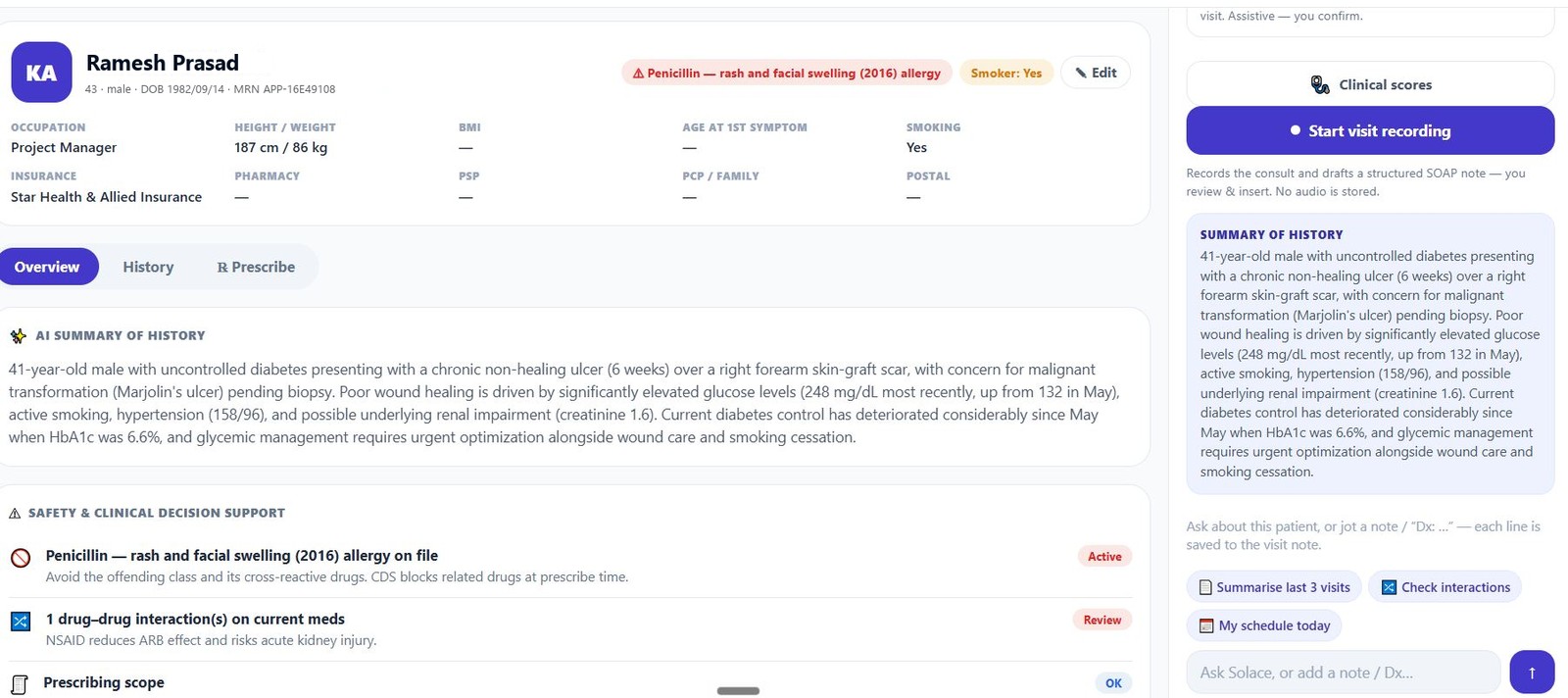
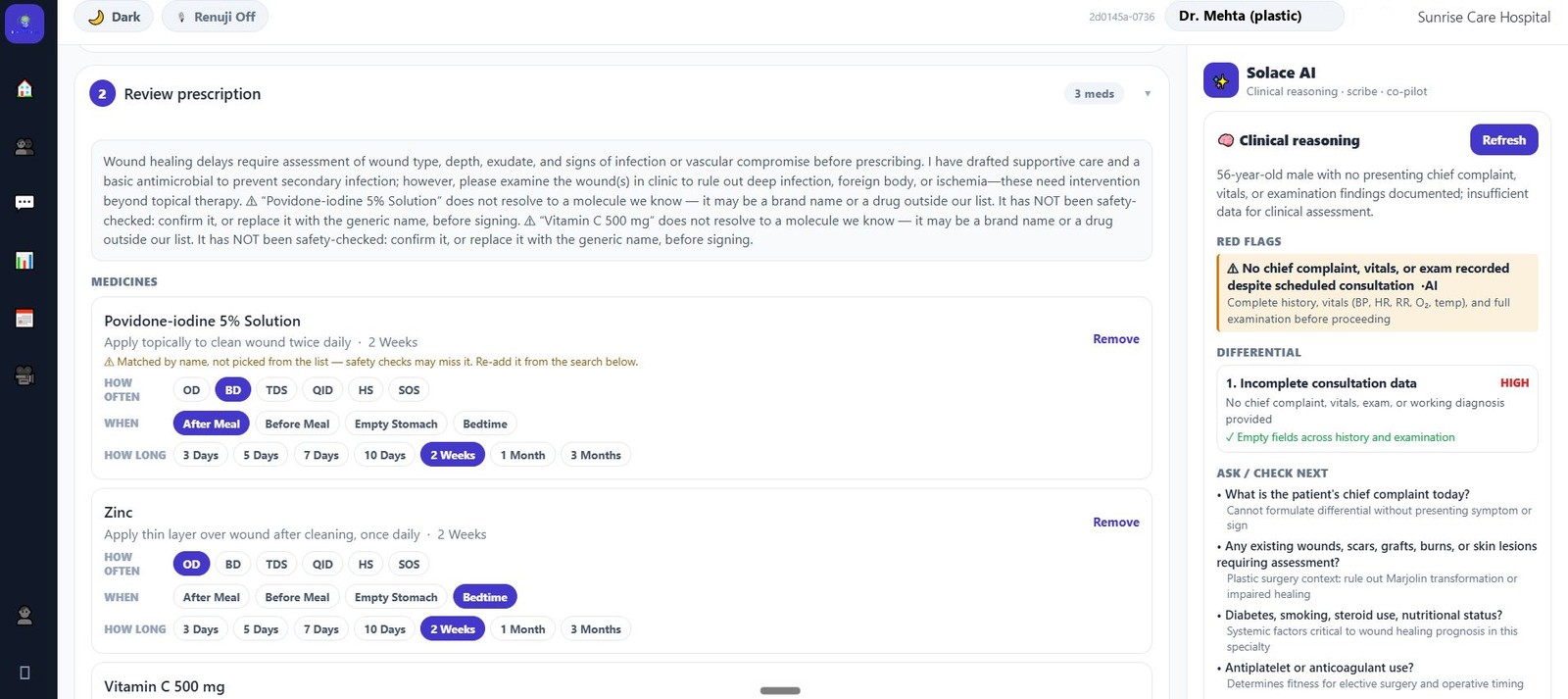
That second warning is the whole argument on this page. Any system can show a green tick. The failure that reaches a patient is a check that quietly did not run and let silence read as “clear”.
Who checks the clinical side
Solace was not designed by engineers and shown to doctors afterwards. Two practising clinicians have worked on it from early on — reviewing the clinical screens as they were built, testing them against real cases, and sending back the ones that would not survive a working day.

Has worked on Solace since its early days — reviewing the clinical screens as they were built, and checking the prescribing flow and its safety warnings against real cases, including the ones where the honest answer is that something could not be verified. Anaesthesia lives on drug interactions, allergies and weight-based dosing, which makes it a demanding place to test those checks from.
MBBS, Vardhman Mahavir Medical College & Safdarjung Hospital, New Delhi (2009). MD in Anaesthesia, Atal Bihari Vajpayee Institute of Medical Sciences & Dr RML Hospital, New Delhi (2014), with senior residency at Dr RML.
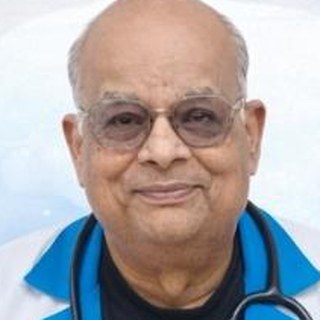
Has tested Solace against the thing that decides whether clinical software survives at all: a full outpatient day. His review is about ease of use — whether a consultation still runs at its own pace with the software in the room, how much a doctor is actually asked to type, and which “helpful” prompts simply get ignored. Several screens were rebuilt because of it.
MBBS and MS, in ENT practice for forty-six years, currently at Apollo Clinic, Greater Noida.
Hospital affiliations are shown to identify each clinician and do not imply endorsement of Solace Health by Max Healthcare, Apollo, or any other institution.
Language
A voice assistant that only understands textbook Hindi is a demo, not a product. Patients in Bihar, Jharkhand and eastern Uttar Pradesh do not speak textbook Hindi.
Where we are honest about the limits. The Indic dialect work is built and running, and it is still being reviewed by native speakers region by region. We would rather tell you that than let you find out from a patient.
Under the bonnet
The AI is not one vendor welded into the product. Which model answers a clinical question is a setting on your hospital, not a decision we made once for everybody.
The doctor-facing clinical chain, the patient-facing assistant and the phone receptionist run on different models, chosen for what each one has to be good at.
The AI is region-scoped to India. Where a capability genuinely is not available in an Indian region, we say so rather than quietly routing your data elsewhere.
Safety checks, panic values and red flags are deterministic rules — not something a model is asked to remember. The model writes the language; the rules make the judgement.
The safety checks are the part we are proudest of, and they are the part that is impossible to judge from a slide. Bring a case and we will run it.